Cat Coloring Pages — Free Printable PDF
Free printable cat coloring pages: realistic breeds, kittens, and cartoon cats with plenty of attitude. Each sheet is a print-ready PDF by Papaya Ink that fits US Letter and A4. Open a collection below and click any picture to get it at full size.
Show me
Showing only sets with black & white pages.
Showing only sets with color sample pages. 1 other set is hidden.
No black & white sets here yet - showing everything.
No sets with a color sample here yet - showing everything.

About Cat Coloring Pages — Free Printable PDF
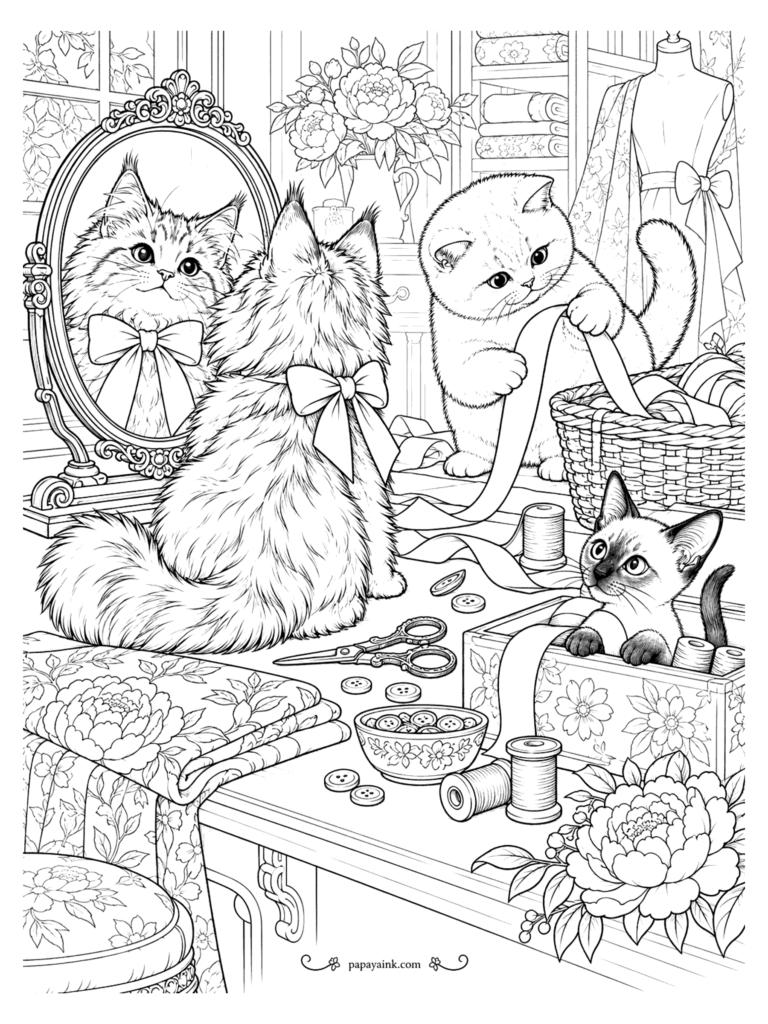
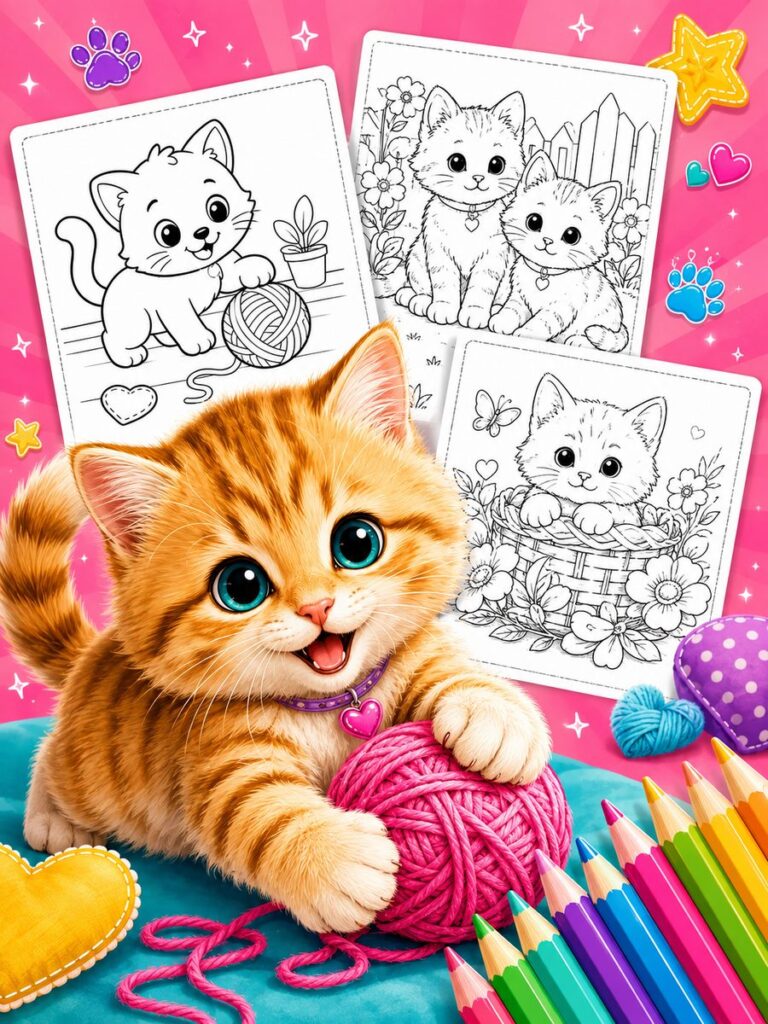
A cat can be drawn with six lines or six hundred, and both versions are here. The realistic cat coloring pages show real breeds with correct proportions - the heavy ruff of a Maine Coon, the flat profile of a Persian, the long legs of a Siamese - and name the breed wherever one is shown. The lighter collections are about character: kittens in boxes, cats on windowsills, cute, round-faced cartoon cats doing things no cat would agree to. Many collections come both as plain black-and-white line art and with a finished color sample printed on the same sheet.
With cats, the coat matters more than the pedigree. Most cats in the world belong to no breed at all - they are simply domestic shorthairs and longhairs - and what tells them apart is pattern. The most common is tabby, which comes in four versions: mackerel, with narrow stripes running down the sides like fish bones; classic, with broad swirls and a bullseye on each flank; spotted; and ticked, where every hair is banded and the body looks almost plain. Whatever the version, a tabby wears an M on its forehead, and that letter is worth drawing in first.
Other patterns have names of their own. A tuxedo cat is black with a white chest and paws. A calico has three colors in clear patches - white, orange and black - while a tortoiseshell mixes black and orange with little or no white. Nearly all calico and tortoiseshell cats are female. Orange cats are the opposite: most are male, and every one of them is a tabby, even when the stripes are faint. Solid coats exist too - black, white, and the gray that cat people insist on calling blue.
Breeds add their own rules. Siamese, Ragdoll and Birman cats are pointed: a pale body with a darker face, ears, paws and tail, and always blue eyes. The Russian Blue is solid blue-gray with green eyes; the British Shorthair is best known in the same blue, with round copper eyes. A Bengal carries leopard-style rosettes on a golden coat, an Abyssinian is ticked in warm reddish brown, and a Bombay is black from nose to tail. Among the longhairs, the Maine Coon and the Norwegian Forest cat are big, shaggy and often tabby, and the Persian comes in almost every color there is. Then there are the cats known by shape rather than color: the hairless Sphynx, the Scottish Fold with its folded ears, the curly-coated Devon Rex, the tailless Manx and the short-legged Munchkin.
Some facts are worth knowing before the first pencil comes out. All kittens are born with blue eyes, and the adult color - green, gold or copper - arrives over the first few months. Pointed kittens are born nearly white and darken as they grow. In bright light a cat's pupils narrow to vertical slits; in dim light they open into full circles, so the same cat can be drawn either way. Nose and paw pads follow the coat: black on a black cat, pink on an orange or white one, mottled on a tortoiseshell. A white cat may have one blue eye and one gold.
Striped and spotted coats go faster if you color in the right order: lay down the lighter base color over the whole cat, then draw the darker markings on top, curving them around the body the way they would wrap around a cylinder. A black cat should not be flat black - build it from dark blue, purple and brown, and leave narrow strips of paper showing along the back and the edge of the ears, where the light catches. For long fur, use strokes as long as the hair itself. Whiskers are easier to save than to add: go around them, or draw them last with a white gel pen.
Difficulty varies from sheet to sheet. Easy cat coloring pages have thick outlines and large shapes, good for a first try, for small children, or for a ten-minute break. The detailed ones, with full fur texture and busy backgrounds, are meant for adults and older kids who like to settle in with a set of sharp pencils.
Cat people will find their own uses. Color a sheet in the exact markings of a cat you know and it turns into a portrait for the fridge or a card for its owner. Rescue groups can print them for adoption events, teachers for a unit on pets, and a finished page makes an easy present for anyone who has ever been owned by a cat.
All of it is free. Every sheet downloads as its own PDF, laid out for US Letter and equally at home on A4, and most collections also offer the whole set as one PDF book. Ordinary printer paper works for pencils and crayons; switch to heavier stock for markers, gel pens or watercolor.