Princess Coloring Pages — Free Printable PDF
Free printable princess coloring pages: ball gowns with trains, tiaras and crowns, castles with a hundred windows, carriages, garden tea parties and the occasional dragon who turned out to be friendly. Pick a collection below, click any picture and it opens as a PDF sized for US Letter that also fits A4. Every princess here is an original Papaya Ink character, drawn for this site and not borrowed from any film, show or book.
Show me
Showing only sets with black & white pages.
Showing only sets with color sample pages. 2 other sets are hidden.
No black & white sets here yet - showing everything.
No sets with a color sample here yet - showing everything.
About Princess Coloring Pages — Free Printable PDF
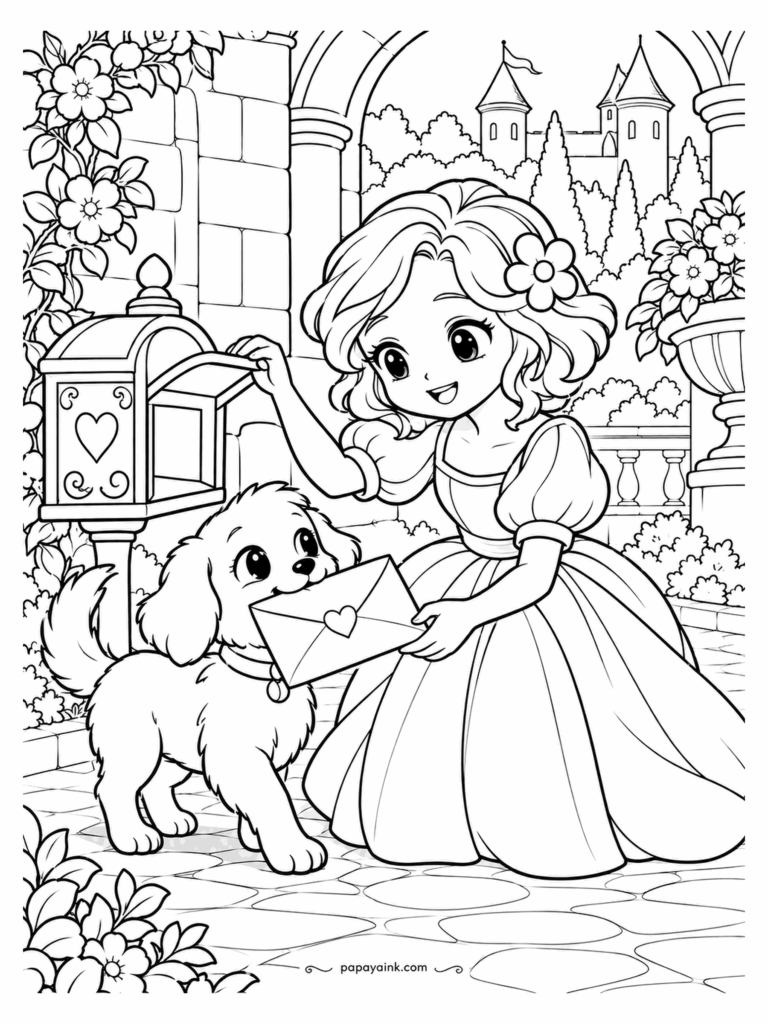
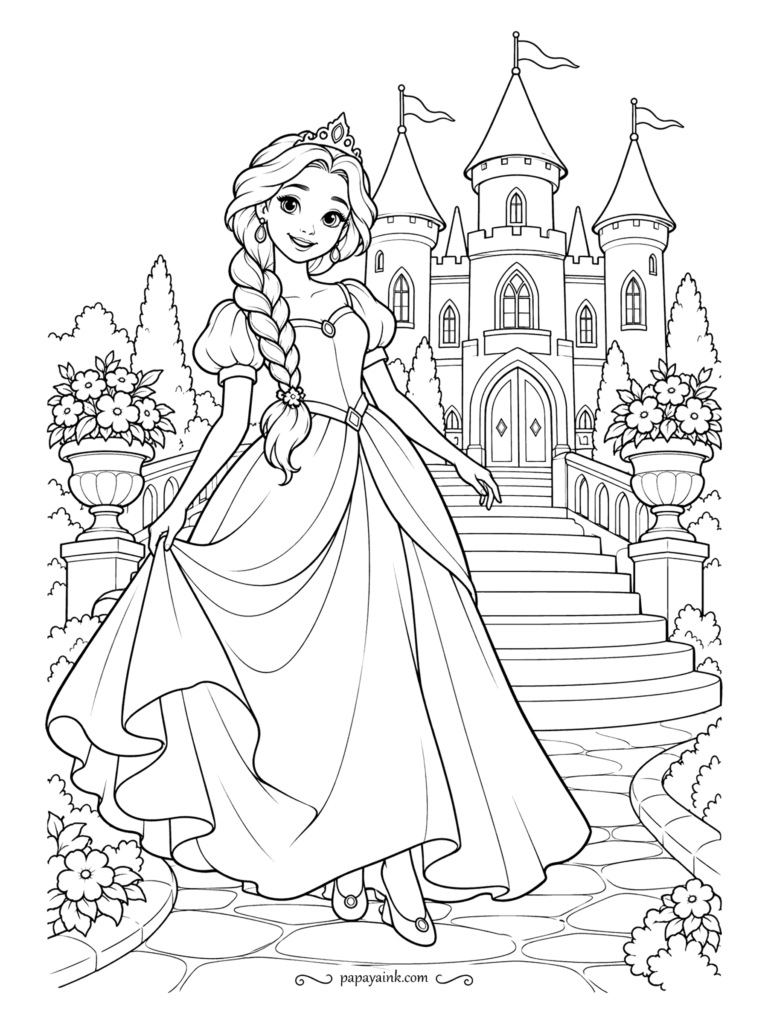
A princess page is really a costume page. The face takes a minute; the dress takes the evening. That is why the subject works so well for coloring: there is a tiara to make glitter, lace to shade, a satin skirt that has to look as if light is sliding off it, and behind all that a throne room or a rose garden that can be as simple or as busy as you like. Most of the pages in this section were drawn with adults and older kids in mind - detailed gowns, embroidered bodices, chandeliers, marble floors - and the rest are open, friendly sheets for small hands, with big crowns and bigger skirts.
Here is what lives in this section. Princesses in their castles: on balconies, on spiral staircases, in libraries taller than the room, in kitchens where the royal cake is going wrong. Princesses outdoors: riding through a forest, feeding swans, picking apples, sailing a boat, walking a dog that is not quite a royal breed. Princesses with company: a unicorn, a baby dragon, a fox, a cat in a tiny matching crown, a visiting fairy. The dresses range from medieval gowns with long pointed sleeves to the huge skirts of the eighteenth century and the slim silhouettes of the twenties, so there is a princess for every taste in fabric. Some collections are drawn in the kawaii or chibi style, round-faced and three heads tall; others follow anime proportions with big shining eyes; others again are closer to a storybook illustration, with careful hands and real folds in the cloth.
A little history helps with the details. Fairy-tale princesses are older than the printed books that made them famous: the tales were told aloud for centuries before Charles Perrault wrote his collection down in 1697 and the Grimm brothers published theirs in 1812. In those older versions the heroine's dress is usually described in one line - gold, silver, "the color of the sun" - and everything else is left to the listener. A coloring page is the same deal. The outline sets the pose and the shape of the gown; the color is yours, and there is no wrong answer.
Crowns and tiaras are not the same thing, and the difference is easy to draw. A crown is a full circle and sits on top of the head. A tiara is open at the back, rests above the forehead and is held in place by the hair, which is why it suits an updo with a few loose curls. Real tiaras are built on a hidden frame of silver or gold and set with the family's stones, and the big, high points were a nineteenth-century fashion. On paper, a tiara needs very little color: a warm yellow or a cool gray for the metal, one bright color inside each stone with a white dot left untouched for the sparkle.
The big skirt has engineering underneath. Gowns of the sixteen and seventeen hundreds stood out that far because of a frame of hoops or a stiffened petticoat, and the fabric was gathered and stitched over it; the folds you see on a coloring page follow that frame. Satin is shiny because the thread floats on the surface: shade it with a dark tone in the deep folds and leave a pale stripe along every ridge. Velvet is the opposite, soft and matte, with the shadows blurred rather than crisp. Lace and embroidery are best left for last, in a slightly lighter color than the cloth, and only where the drawing gives you a pattern to follow.
Pink is a habit, not a law. For most of history royal children of both sexes were dressed the same, and when colors were assigned at all, a trade magazine in 1918 was still advising pink for boys and blue for girls. The rule flipped in the twentieth century and never flipped back, which is why the pink princess feels ancient when she is barely a hundred years old. Try the alternatives: deep emerald with gold trim, burgundy and cream, a midnight blue gown with silver stars, a pale yellow dress against a dark green garden. A coloring page lets a princess wear what a shop would never stock.
Hair and skin come first. A princess can have any complexion and any hair you choose - golden, black, auburn, silver, lilac in the anime pages - and the whole palette of the dress should be decided after that, so the two agree. For hair, color in long strokes that run with the curl and leave a band of paper untouched across the crown of the head; that single highlight is what makes hair look glossy. Blush is one light layer on the cheeks, added last. If the page is in the kawaii style, keep the white sparkles in the eyes and do not fill them in.
Backgrounds decide how long the page takes. Many sheets give you a throne, a staircase, a garden gate or a ballroom with tiled floors, and the fastest way through them is to keep the background two shades lighter than the princess so she stays the brightest thing on the page. For a quick session, color the figure and leave the castle in line art; it looks deliberate, like a fashion plate. For a long evening, do the tiles one by one, give the chandelier a different yellow from the crown, and put a few stars in the window.
Difficulty is marked collection by collection. Easy princess coloring pages have thick outlines and large shapes - one girl, one crown, one plain skirt - and suit preschool, kindergarten and a birthday party table where twenty copies have to be colored in a hurry. The detailed ones, with layered gowns, lace and full castle interiors, are for adults, teens and anyone who keeps a tin of sharp pencils for exactly this kind of thing.
Some collections are classic black-and-white line art. Others are copy coloring sheets: the finished color picture sits above the same outline, so you can copy its palette or treat it as one suggestion among many. The Show me buttons above the collections sort them by kind. Click any picture and the PDF opens in a new tab, US Letter size, which also prints cleanly on A4 with nothing to adjust. Plain printer paper is fine for pencils and crayons; for markers, glitter gel pens or a watercolor wash across a skirt, print on heavier stock. A white gel pen and a gold one are the two tools worth adding to the box for princess pages: one for the sparkle, one for the trim.
Finished princesses rarely stay in a folder. They become party invitations, birthday cards, a paper-doll stand-up on a folded card, a framed picture for a child's room or a garland of crowns across a doorway. All of it is free to print for home, classroom, library or party use. New princess collections are added regularly and the existing ones keep growing, so there is usually a new gown waiting the next time you look.