Horse Coloring Pages — Free Printable PDF
Free printable horse coloring pages - realistic breeds, foals and ponies, horses at pasture and under saddle. Every sheet is a print-ready PDF from Papaya Ink in US Letter size that also fits A4. Choose a collection below; each picture inside opens at full size.
Show me
Showing only sets with black & white pages.
Showing only sets with color sample pages.
No black & white sets here yet - showing everything.
No sets with a color sample here yet - showing everything.
About Horse Coloring Pages — Free Printable PDF
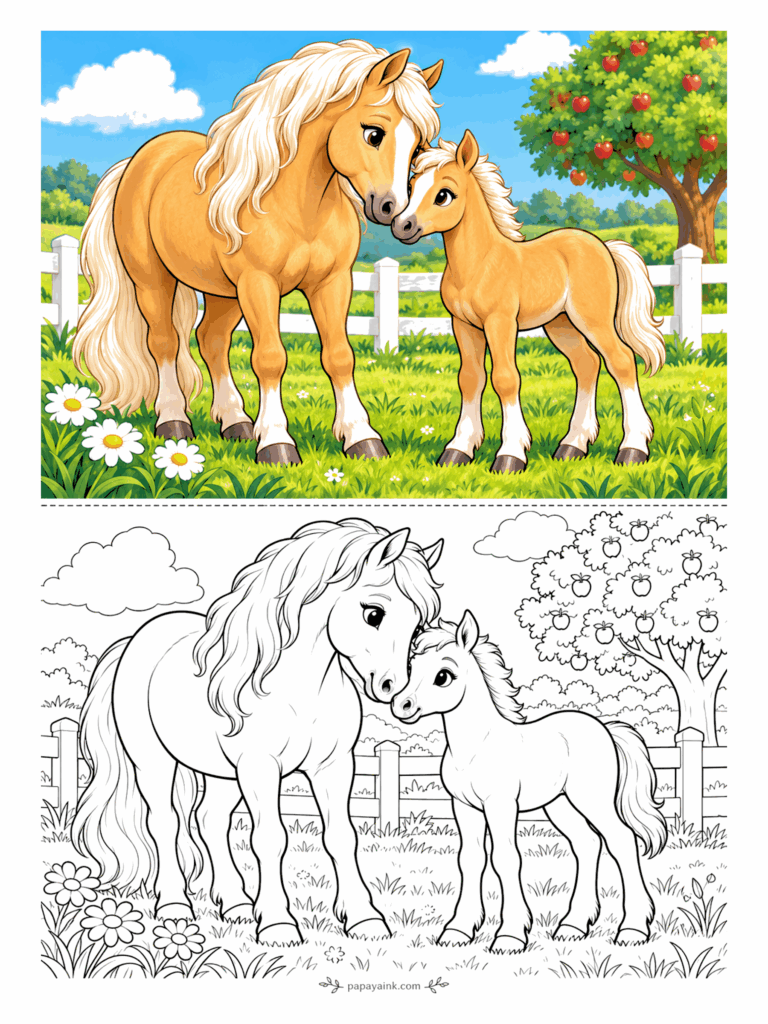
A horse is one of the hardest animals to draw and one of the most rewarding to color, which is a good reason to let someone else do the drawing. The realistic horse coloring pages in this section keep the anatomy honest - the slope of the shoulder, the set of the neck, the angle of each leg - and name the breed wherever one is shown. Other collections are gentler: foals, ponies, and cartoon horses with long eyelashes and no interest in anatomy at all. Many collections come as black-and-white line art and also with a finished color sample printed on the same sheet.
Horse people have a precise word for every coat, and knowing a few of them is enough to color any horse correctly. A bay is brown with black points: black mane, black tail, black lower legs. A chestnut, called sorrel in Western barns, is red all over, with a mane and tail the same shade or lighter and no black anywhere. A black horse is black, and rarer than films suggest. Palomino means a gold coat with a white mane and tail. Buckskin is a similar gold or tan with black points, and a dun adds a dark stripe down the spine.
White is the tricky one. Almost every white horse is really a gray: born dark, it fades a little each year, often passing through a dappled stage of pale circles outlined in darker gray. A roan has white hairs mixed evenly through the body while the head and legs stay dark. A pinto wears large patches of white and color, and an Appaloosa carries spots - sometimes all over, sometimes only on a white blanket across the hips.
Markings finish the portrait. On the face, a star is a white spot on the forehead, a stripe is a narrow line down the nose, a blaze is a wide one, and a snip sits between the nostrils. On the legs, a sock covers the fetlock and a stocking reaches the knee or the hock. One detail is often missed: the hoof below a white leg is usually pale, and the hoof below a dark leg is dark.
Breeds differ more in outline than in color. The Arabian has a dished face and carries its tail high. The Thoroughbred is the lean, long-legged racehorse; the American Quarter Horse is shorter and heavily muscled behind, built for sprinting and cattle work. Mustangs are the free-roaming horses of the American West. The Friesian is black, with a long wavy mane and feathered legs. Draft breeds are the giants: the Clydesdale, usually bay with a white blaze and white feathered legs, the Shire, the gray or black Percheron, and the Belgian. At the other end stand the ponies and small horses - Shetland, Welsh, the golden Haflinger with its pale mane, and the Norwegian Fjord, a dun whose upright mane has a dark stripe running through the middle. The Lipizzaner is born dark and turns nearly white with age, and the Gypsy Vanner combines pinto patches with a great deal of hair.
Three things separate a believable horse from a rocking horse. A foal's legs are almost as long at birth as they will ever be, so a newborn looks like a small body on stilts - that is correct, not a drawing error. At a full gallop all four hooves leave the ground when the legs are gathered under the body, not when they are stretched out. And a horse's eye is large, dark brown and set on the side of the head; a single small highlight is all it needs. As for names: a foal is any young horse, a colt is a young male, a filly is a young female, and the adults are mares and stallions.
A horse's coat is short and glossy, so smooth layers work better than visible strokes. Start with the lightest tone, deepen it along the belly, under the jaw and between the legs, and leave the top of the rump, the shoulder and the cheek almost untouched - that shine is what makes the animal look round. Mane and tail are the opposite: long, loose strokes from root to tip, with a few strands left pale. For a dappled gray, shade the whole coat lightly and lift the pale circles out with an eraser.
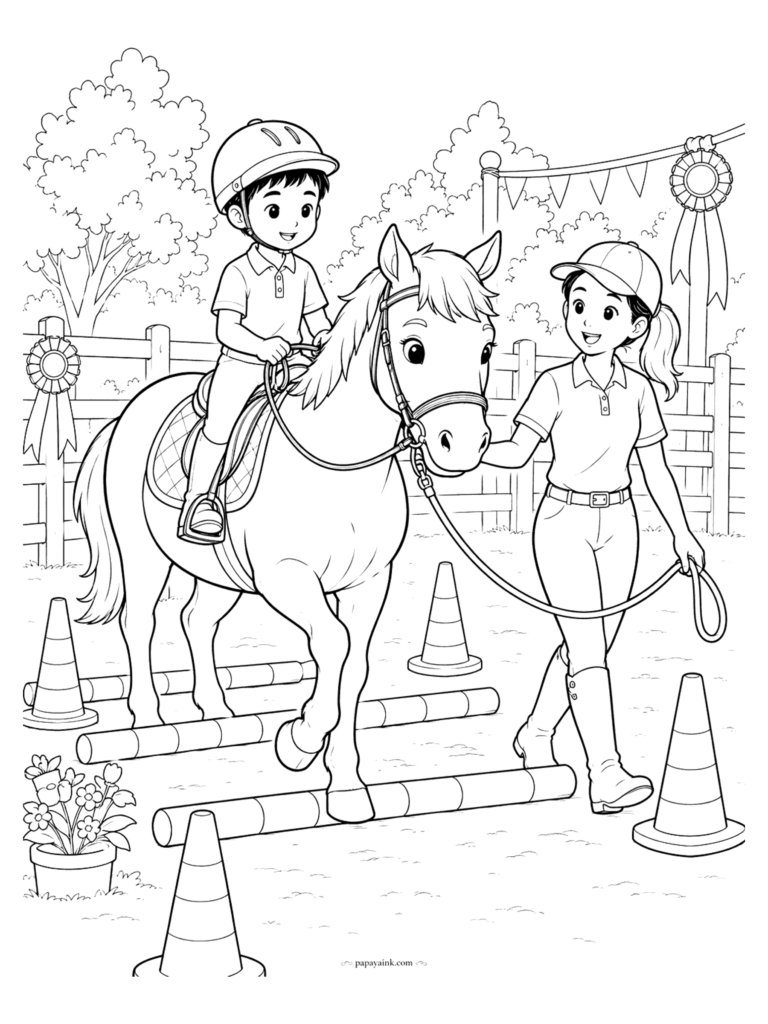
Sheets range from easy to demanding. Easy horse coloring pages use bold outlines and big shapes and suit beginners and young children. The detailed ones, with fine mane work, tack and full landscapes, are for adults, older kids and anyone who grew up drawing horses in the margins of a notebook. If a sheet shows a saddle, the horn at the front tells you it is Western; English saddles have none. Riding schools, pony clubs and summer camps can print these pages by the stack, and a horse colored in the real markings of someone's own animal makes a better card than anything from a shop.
None of this costs anything. Each sheet is its own PDF, set up for US Letter and comfortable on A4, and most collections can be saved whole as one PDF book. Regular printer paper handles pencils and crayons; for markers and watercolor, print on heavier stock.