Winter Coloring Pages — Free Printable PDF
Free printable winter coloring pages, drawn for the cold months: snowmen and snowflakes, animals in their white winter coats, skating ponds and sled hills, cabins with lit windows and the long blue evenings in between. Pick a collection below, click any picture and it opens as a PDF sized for US Letter that also fits A4. Every scene is original Papaya Ink line art, free to print as many times as you need.
Show me
Showing only sets with black & white pages.
Showing only sets with color sample pages. 4 other sets are hidden.
No black & white sets here yet - showing everything.
No sets with a color sample here yet - showing everything.

About Winter Coloring Pages — Free Printable PDF
Winter is the coloring season, and it is easy to see why. The days are short, the evening is long, and a snow scene gives the hand something restful to do: wide drifts, a few dark trunks, one warm window. Most of the pages here were drawn with adults in mind - detailed landscapes, patterned knitwear and snow that needs real shading - with plenty of simpler sheets for kids, classrooms and anyone who wants to finish in ten minutes. The captions in each collection say which is which.
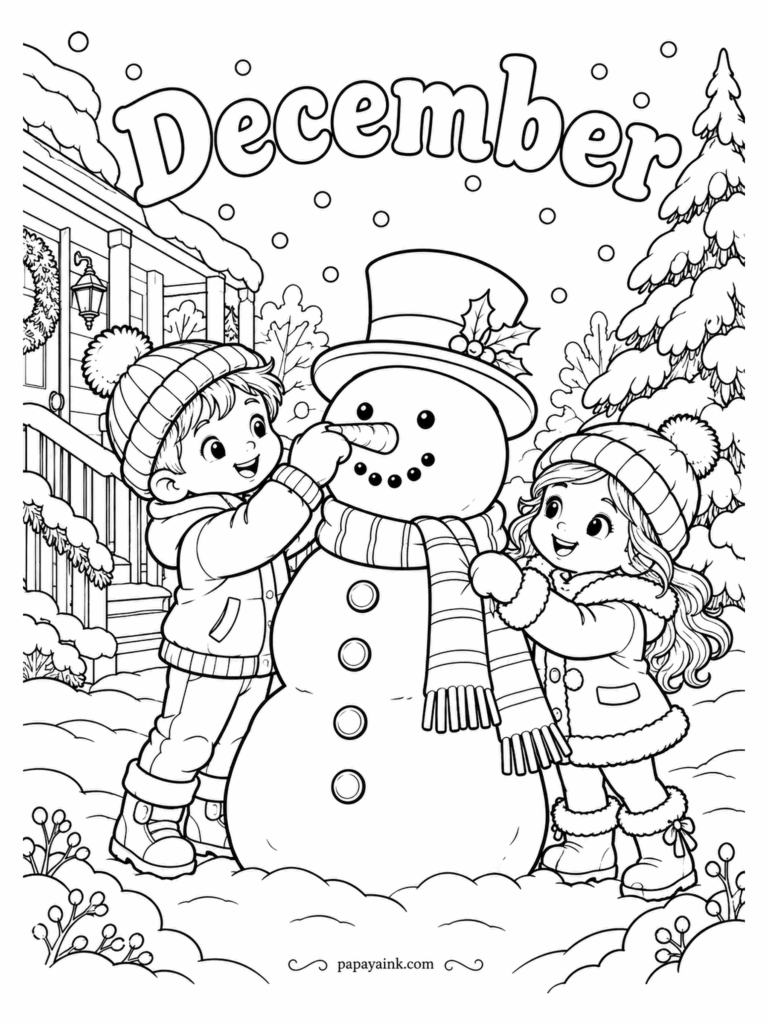
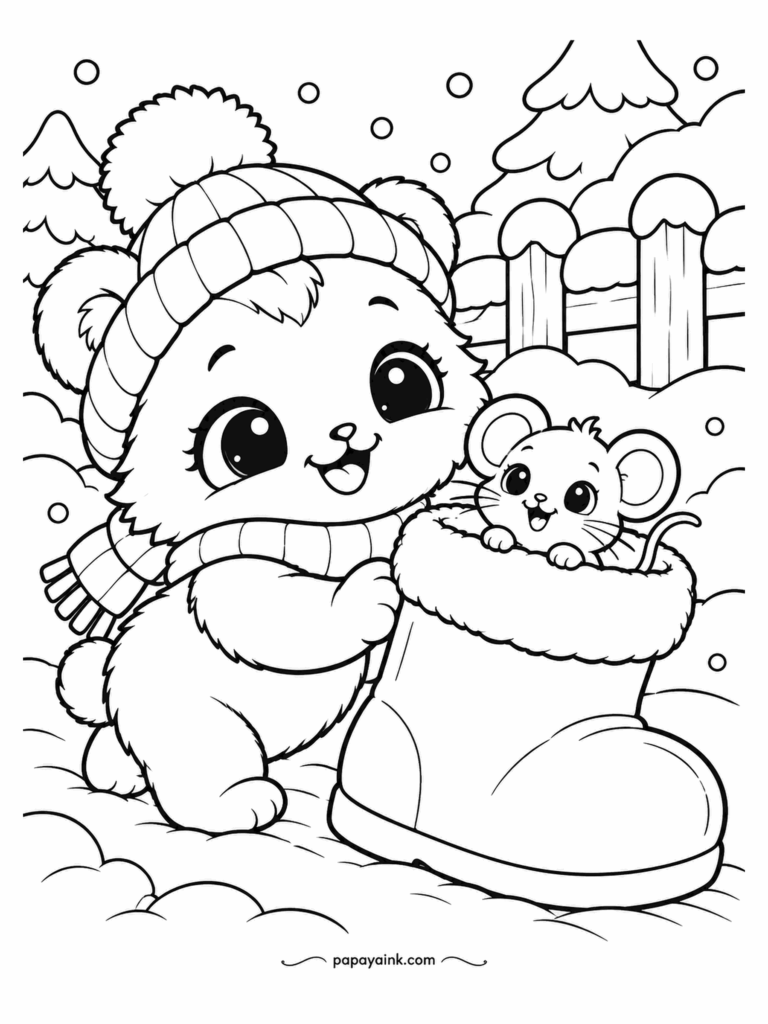
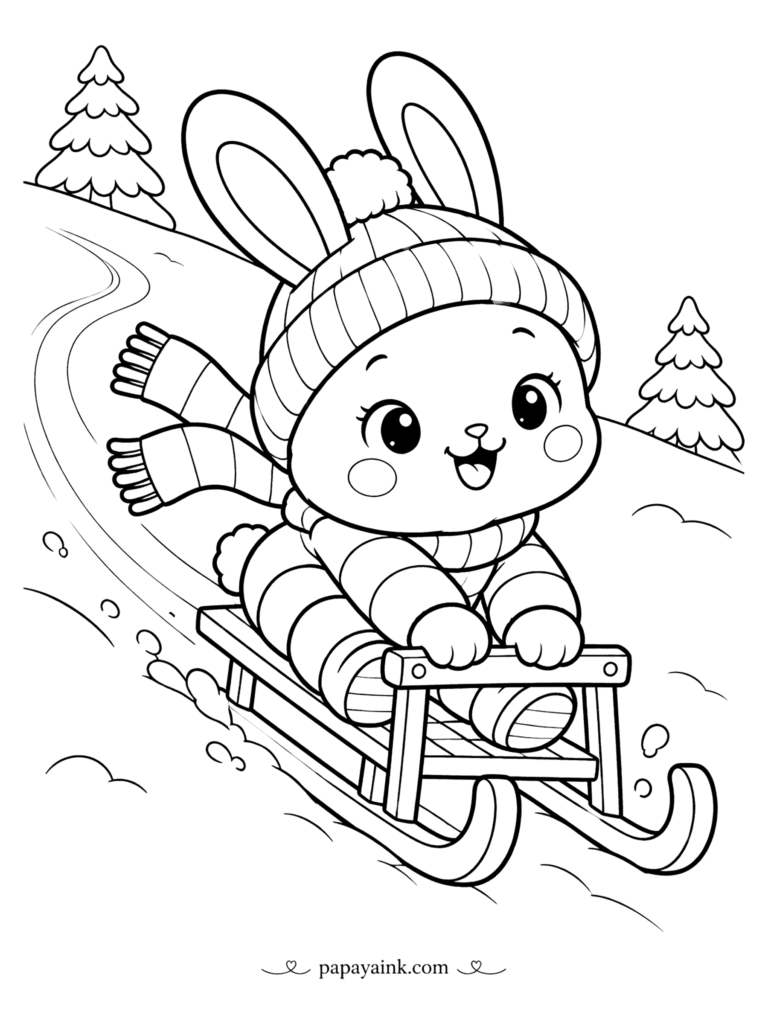
So what is in this section? Snowmen, to begin with: tall ones, round ones, whole families of them, snowmen with birds on their hats and snowmen still being built, rolled across a yard by children in oversized scarves. Snowflakes, as single big crystals to color arm by arm and as flurries drifting over a village. Winter animals - the arctic fox, the snowy owl, the polar bear and the penguin, deer on a frozen meadow, cardinals and chickadees at a feeder, a squirrel digging up a buried acorn, a bear asleep in its den. Winter sports and plain winter fun: ice skating on a pond, sledding, skiing down a quiet slope, snowshoeing through pines, a snowball fight that has gotten out of hand. And the indoor side of the season: cocoa with marshmallows, mittens drying on a radiator, a cat on the sill watching it snow, a log cabin at dusk, a lantern on a snowy path. Winter does not end with the holidays, so most of these scenes belong to the whole season, from the first flurry to the muddy thaw.
A few facts to keep in mind before the pencils come out. Snow is not white. It is clear ice in trillions of tiny pieces, and it only looks white because the crystals scatter every color of light at once. That is why a snowbank in sunlight is the brightest thing in a landscape and why its shadows are blue: they are lit by the sky, not the sun. On the page, the trick is to leave the snow as bare paper and color everything around it. A pale blue or lilac pencil in the shadows, a touch of warm yellow where a window or a lantern falls on the drift, and the white suddenly reads as snow instead of nothing.
Every snowflake has six arms, never five or eight, because water freezes into a six-sided lattice. The arms match each other because all six pass through the same air at the same moment, and their shape depends on the temperature and moisture they met on the way down: flat plates in one layer of cloud, needles in another, the big feathery stars when the air is just below freezing and heavy with water. Wilson Bentley, a farmer in Vermont, photographed the first snow crystal through a microscope in 1885 and spent the rest of his life catching them on black velvet, more than five thousand in all. If a snowflake on a coloring page looks too perfect to be real, it was probably drawn from one of his.
Animals change for the season too, and those changes are a gift to anyone holding a box of pencils. The arctic fox, the snowshoe hare, the stoat and the ptarmigan all trade brown for white as the days shorten, and grow their brown back in spring. Deer and moose put on thick gray-brown winter coats, and by late winter many bucks have dropped their antlers. Birds fluff their feathers to trap warm air, which is why a chickadee in January looks like a tennis ball. A cardinal keeps its red all year, and against snow it is the loudest spot of color in the forest - save it for last and put it down in one bold layer.
The snowman has a longer history than the cartoons suggest. The earliest known drawing of one sits in the margin of a Dutch prayer book from around 1380, and in the winter of 1494 Michelangelo was asked to build a snowman in the courtyard of a Florentine palace. The three-ball figure with the carrot nose is mostly an American habit; across Europe he is often two balls, or one tall heap with a face. On paper a snowman has almost no color of his own, so the fun moves to his accessories: the scarf, the hat, the mittens, the broom, the bird that has decided to live on his head.
Coloring winter well comes down to contrast: a few dark shapes against a lot of light. Do the sky first and decide what time it is - pale lemon and gray for a snowy noon, peach fading to violet at dusk, deep navy with stars for night. Keep the snow untouched except for its shadows, and let the shadows follow the direction of the light. Bare trees are dark brown or purple-gray, never black; evergreens look cold if you mix a little blue into the green. Ice is the sky again, reflected and slightly darker, with a few bare white streaks left for the shine. Knitted hats, scarves and sweaters take stripes and small patterns well, even in flat marker. Warm colors - a red coat, a yellow window, the orange of a fire - are strongest when they are the only warm thing on the page, so use them in one or two places and let the rest stay cool.
The easy winter coloring pages have bold outlines and big shapes: a single snowman, one snowflake, a mitten, a penguin on the ice. They suit preschool and kindergarten, a snow day at home, or a trial run with new markers. The detailed ones - full winter scenes with whole villages and frozen forests, a cabin interior with every mug and blanket drawn in - are for adults and older kids who like to settle in for an evening. Teachers print them for the first week back in January, when a class is restless and a quiet half hour is worth more than a worksheet, and they are a favorite in senior centers, waiting rooms and the back seat on long winter drives.
Some collections are classic black-and-white line art. Others are copy coloring sheets: the finished color picture sits above the same outline, so you can follow the palette or ignore it completely. The Show me buttons above the collections sort them by kind. Each picture opens as a PDF in a new tab, sized for US Letter and equally at home on A4, so it prints at full size with nothing to adjust. Ordinary printer paper is fine for colored pencils and crayons; for markers, gel pens or a watercolor sky, print on heavier stock. A white gel pen earns its place within reach for falling snow and the sparkle on a drift.
Finished pages rarely stay in a drawer in winter. Fold one in half for a card, hang a colored snowflake in the window, tape a row of snowmen along a classroom wall, or frame a snowy cabin for the hallway until spring. Everything in this section is free to print for home, classroom, library or community use. New winter collections are added through the season and the existing ones keep growing, so come back when the forecast says snow.