
Flower Coloring Pages — Free Printable PDF
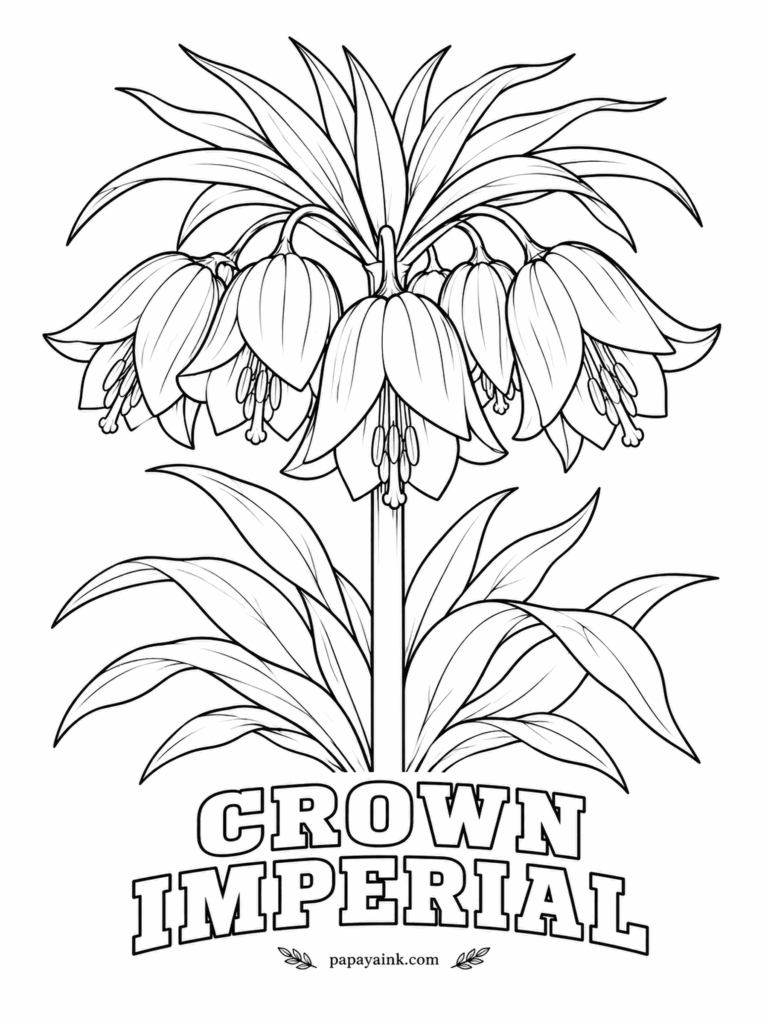
Free printable flower coloring pages, gathered in one place: roses and sunflowers, tulips and daisies, lilies, orchids, poppies, cherry blossom, whole bouquets and single blooms drawn large enough to fill a page. Pick a collection below, click any picture and it opens as a PDF sized for US Letter that also fits A4. Every drawing is original Papaya Ink line art, free to print as many times as you need.
Show me
Showing only sets with black & white pages.
Showing only sets with color sample pages. 4 other sets are hidden.
No black & white sets here yet - showing everything.
No sets with a color sample here yet - showing everything.

About Flower Coloring Pages — Free Printable PDF
Flowers were the first thing most of us ever colored, and they are still the subject adults come back to most. The reason is simple: a flower has no wrong color. A dog has to be brown or black, a sky has to be blue, but a rose can be yellow, coral, lavender or striped, and nobody will say it looks wrong. The shapes are forgiving too. Petals are big and open, leaves are long and smooth, and a wobbly line at the edge of a bloom only makes it look more like something that grew. That is why flower pages work for a ten-minute break with a child and for a whole evening with a sharpened set of pencils.
A little botany makes the pages more fun. The colors come from two families of pigments: carotenoids make the yellows and oranges of a sunflower or a marigold, and anthocyanins make the reds, pinks, purples and blues of roses, violets and cornflowers. White petals contain no white pigment at all; they are full of tiny air pockets that scatter light, the same trick that makes snow look white. Many flowers also carry patterns we cannot see, lines and spots in ultraviolet that point a bee straight to the nectar. The visible version of those marks is the darker stripe or ring at the base of a petal, and shading it in is the fastest way to make a flower look real.
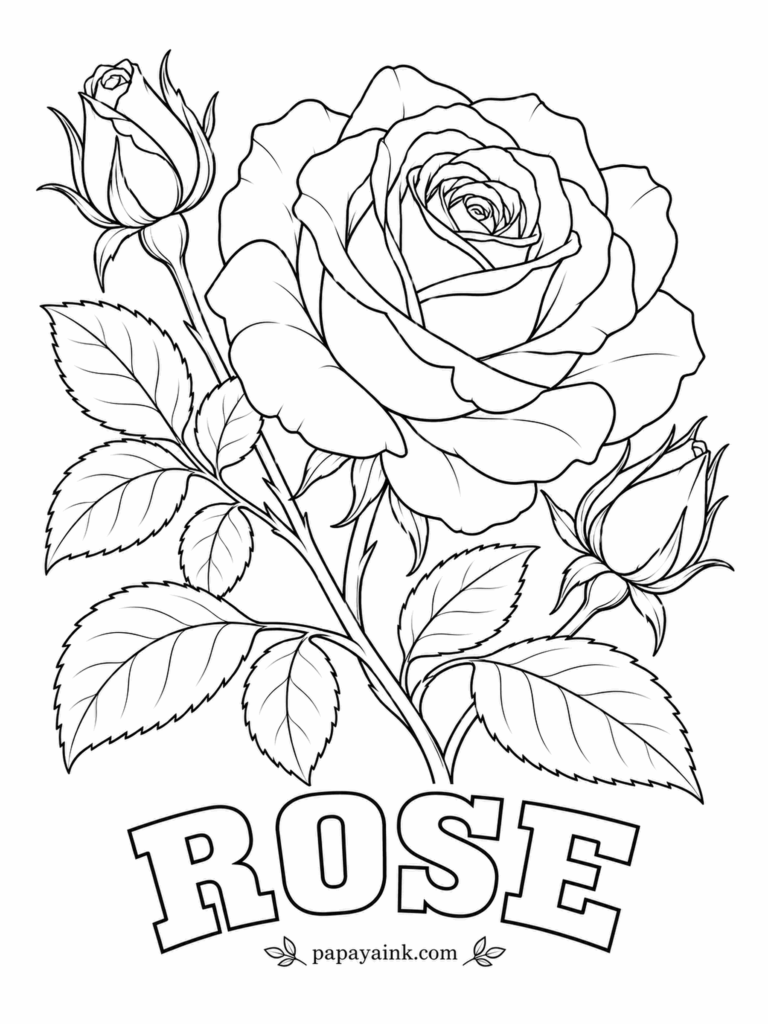
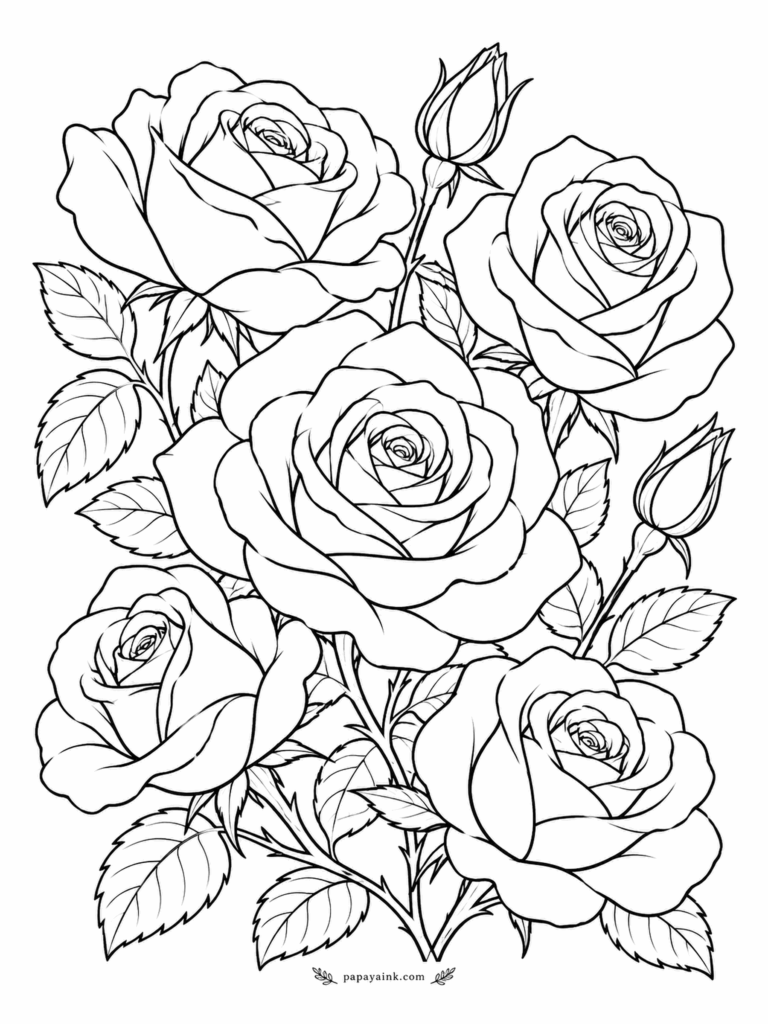
The rose is the flower people ask for most, and it has a longer history than almost any other garden plant: rose fossils are around 35 million years old, and a climbing rose on the wall of a cathedral in Hildesheim, Germany, is said to have been growing for about a thousand years. Roses are relatives of apples, pears and strawberries, which is why the fruit of a rose, the rose hip, looks like a tiny apple. On paper a rose is a spiral: start at the tight center and work outward, keeping the inner petals darkest and letting each outer layer go a little lighter.
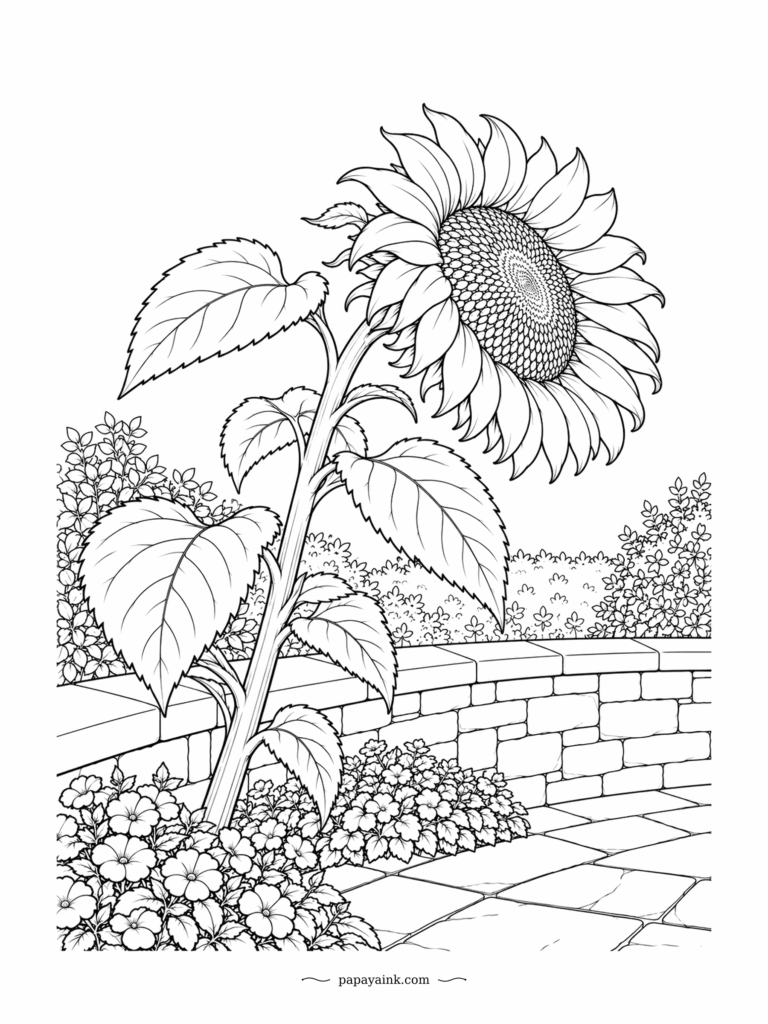
The sunflower does something odd. A young sunflower turns its head to follow the sun across the sky, east in the morning and west by evening, then swings back overnight. Once the flower matures it stops moving and faces east for good, which is why a whole field of sunflowers looks in the same direction. The brown center is not one flower but hundreds, arranged in two sets of spirals that run in opposite directions. Count them on a real sunflower and you will usually find 34 and 55, or 55 and 89, numbers from the Fibonacci sequence. A sunflower page rewards a warm yellow on the petals, a darker orange where they meet the center, and short dark strokes in the middle rather than a flat brown fill.
Tulips once cost more than a house. In the Netherlands in the 1630s, bulbs of rare striped varieties changed hands for sums that could have bought a canal-side home, until the market collapsed in 1637. The stripes, it later turned out, were caused by a virus. Tulips are also one of the few cut flowers that keep growing in the vase: the stems lengthen by an inch or more and bend toward the window, which is why a tulip bouquet never looks the same two days running. The cup shape is easy to color, with one side of each petal light and the other side shaded.
The daisy got its name from "day's eye", because it opens at sunrise and closes at night. Like the sunflower, it is a composite: the white petals are each a separate flower, and the yellow center is a crowd of hundreds more. Lilies are the opposite, six large petals around a tall center, and they are a good place to practice a gradient from a deep color at the throat to nearly white at the tips. Orchids make up one of the two largest plant families on earth, with around 28,000 species, and vanilla is one of them; their speckled, mirror-image petals are the most detailed flowers in this section. The hibiscus, the state flower of Hawaii and the national flower of Malaysia, opens for a single day and then drops, so a hibiscus page is a flower at its one perfect moment.
Some flowers carry stories. Lotus seeds recovered from a dry lake bed in China sprouted after roughly 1,300 years, among the oldest seeds ever brought back to life, and the lotus leaf is so good at shedding water and dirt that engineers copied its surface for self-cleaning paint. The cherry trees that bloom around the Tidal Basin in Washington, D.C., were a gift from the city of Tokyo in 1912, and the first two were planted by the First Lady and the wife of the Japanese ambassador. Hydrangeas change color with the soil: acid ground gives blue flowers, alkaline ground gives pink, and gardeners bury nails or pour in coffee grounds to push a bush from one to the other. The name lavender is usually traced to the Latin word for washing, because the Romans put it in their baths.
Coloring flowers well comes down to one habit: never fill a petal with a single flat color. Lay down the lightest tone over the whole petal, then darken the base where it meets the center and the places where one petal slips under another. Leave a thin edge of bare paper along the rim of a petal that catches the light. Leaves are the same in green: darker near the stem and along the central vein, lighter at the edges, and never the same green as the leaf next door. For a bouquet, decide which flower is in front and give it the strongest color; everything behind it gets a lighter, cooler version of its own hue. A white gel pen puts the shine back on a dewdrop and the pollen dust on a stamen.
Difficulty varies from sheet to sheet. The easy flower coloring pages have thick outlines and large shapes, a single bloom or a simple stem, and suit preschool, a classroom table or a first try with new markers. The detailed ones, with full gardens, bouquets in vases, patterned petals and botanical studies labeled by name, are for adults, teens and anyone who likes to settle in for an evening. Teachers print them for a spring unit on plants, florists keep a stack for the counter, and the big open shapes make flower pages a favorite in senior centers and waiting rooms.
Some collections are classic black-and-white line art. Others are copy coloring sheets: the finished color picture sits above the same outline, so you can follow the palette or ignore it completely. The Show me buttons above the collections sort them by kind. Each picture opens as a PDF in a new tab, sized for US Letter and equally at home on A4, so it prints at full size with nothing to adjust, and you can pick several sheets and download them in one go. Ordinary printer paper is fine for colored pencils and crayons; for markers, gel pens or a watercolor wash across a garden, print on heavier stock.
Finished flowers rarely stay in a drawer. Cut one out for a birthday card, press a colored bouquet into a frame for the kitchen, fold a sheet into a gift tag or tape a row of tulips along a classroom wall in March. Everything in this section is free to print for home, classroom, library or community use. New flower collections are added regularly and the existing ones keep growing, so come back when something new is in bloom.